Facebook
 X
X
 Pinterest
 Copy Link
What Should an Agent Expect From Their Brand in 2026?

The expectations placed on real estate professionals continue to grow.
Agents are navigating changing market conditions, evolving consumer expectations, new technology and an increasingly complex business environment — all while building their own brands, generating business and maintaining relationships with clients.
It raises an important question: as the role of the agent evolves, should the expectations they have of the brand behind their business evolve too?
A recognizable name still matters. But in 2026, a brand should be more than something that appears on a business card or a lawn sign. The real value is in what stands behind that name — the technology, marketing, people, leadership and network that help an agent build their business.
For agents evaluating what they need from a brokerage or brand today, there are a few areas worth considering.
Human support still matters
As more of the real estate business becomes technology-enabled, it can be tempting to assume that every challenge needs another digital solution.
It doesn’t.
There are moments when an agent needs a person — someone who can answer a question, help solve a problem, provide perspective or simply point them in the right direction. That starts with your broker’s leadership. The person who values providing a staff that supports agents, and understands that being a mentor and business advisor is investing in their agents’ success.
Technology can create efficiency. Human support can provide context, experience and confidence. Agents shouldn’t necessarily have to choose between the two.
Technology should make the business easier
Real estate professionals certainly don’t have a shortage of technology.
From CRMs and marketing platforms to transaction management and emerging AI tools, agents have more technology available to them than ever before. But having access to more tools doesn’t necessarily make it easier to run a business.
The better question is whether those tools remove friction.
Technology should help agents organize their business, stay connected with clients, market themselves effectively and spend more of their time on the work where their expertise matters most.
And access is only part of the equation. Technology creates value when agents understand how to use it and can get help when they need it.
Find out what tools your brand offers and what kind of support you’ll have to help you optimize using those tools.
Marketing support should help agents build their own business
The strongest relationship between an agent and their brand shouldn’t diminish the agent’s identity, it should help strengthen it.
While individual agents look to differentiate themselves in their local market, he or she likely chose their brokerage because of the brand name and recognition. A strong brand can help agents establish credibility, communicate consistently and remain visible in the communities they serve.
Templates and marketing materials can help, but so can education, strategy and resources. Agents should look for opportunities to leverage the strength of their brand to help build their business.
Real estate is national, but the business is still local
Canada’s real estate landscape is anything but uniform.
The realities facing an agent in Vancouver can be very different from those facing someone in Calgary, Toronto, Montreal or a smaller community elsewhere in the country.
That’s why local brokerage leadership remains important.
A national brand can provide scale, resources and recognition, but strong local leadership helps translate those advantages into something relevant to the market an agent actually serves.
For CENTURY 21 Canada, being proudly Canadian also shapes that perspective. After 50 years in Canada, we understand that there is no single Canadian real estate market. The strength of a national network comes from combining broader resources with professionals and brokerages that understand their communities.
As the industry continues to evolve, agents should expect the organization behind them to evolve too — providing the tools, brand strength, leadership and support they need to move their business forward.
At CENTURY 21 Canada, it’s an approach we think of simply as:
Tech when you want it. People when you need them.
Explore CENTURY 21 →
CENTURY 21 In Town grows into Deep Cove with top Canadian REALTOR Patricia Houlihan
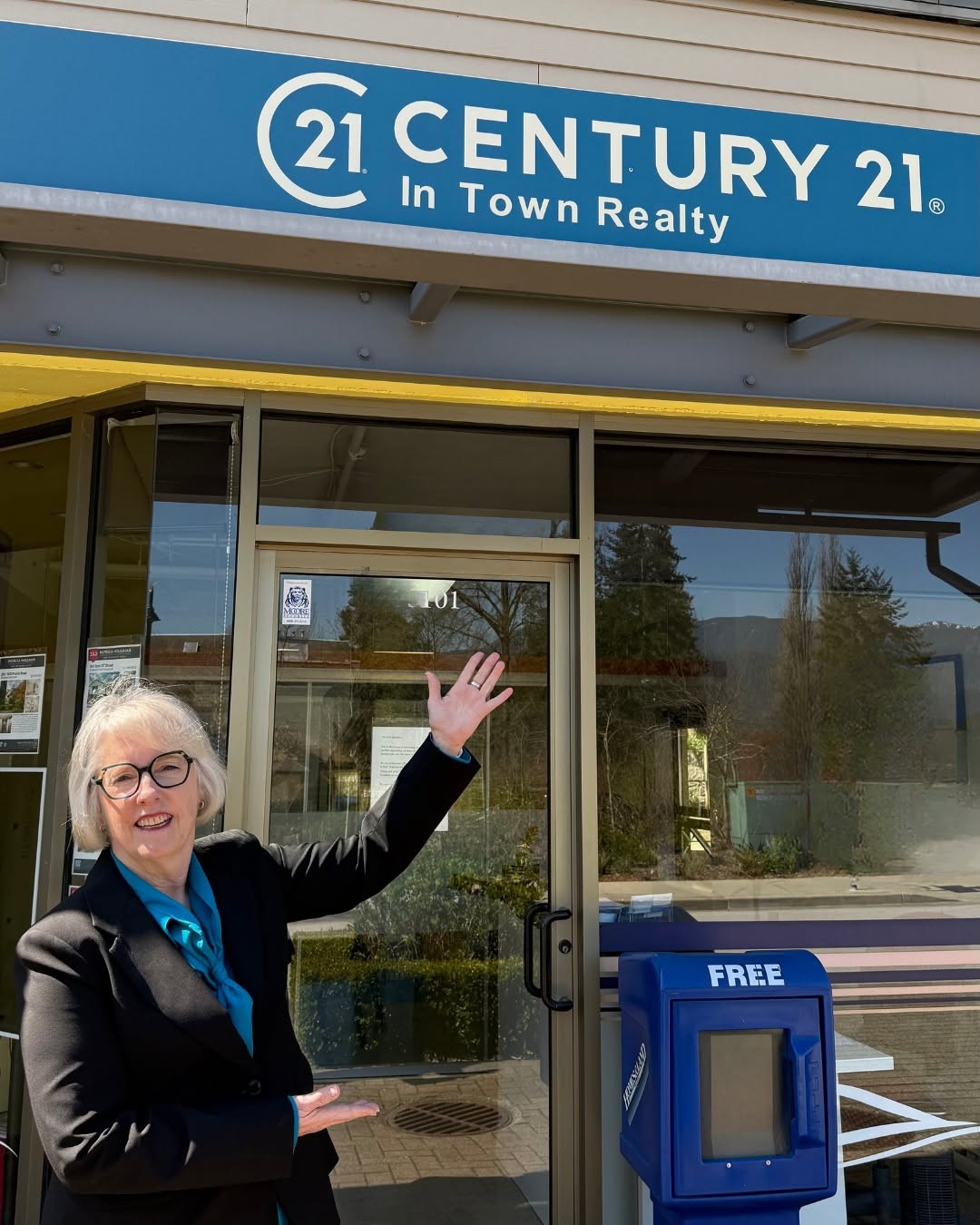
CENTURY 21 In Town Realty has grown into North Vancouver with the recruitment of top Canadian REALTOR Patricia Houlihan.
“I had known of Patricia for years, she had signs all over my neighbourhood,” recalls C21 In Town owner Michael LaPrairie. It was the sale of one of her long-held listings in Michael’s neighbourhood that prompted him to finally reach out.
Their first meeting led to longer conversations, and Patricia officially joined the CENTURY 21 Canada brand earlier this year. “He was very persistent!” Patricia says of his early efforts. “Other companies had also tried to convince me to move, but when I got to know C21 Canada I immediately connected with a brand that began here in Vancouver, where my family has been for four generations.”
“I had the chance to visit C21 In Town when Michael invited me to some events at his office and I found a great atmosphere. Everyone takes their works seriously, everyone’s a professional and they’re very education oriented. I really valued what I found so his persistence paid off!”
“Patricia knows what she wants, and she’s become a big help in the office,” Michael says. “She participates, she adds value, and she’s a mentor for other agents. Last year her production would’ve put her among the top producers in the C21 system, so I know we recruited a really strong agent.”
Michael credits this recruitment to his brokerage’s emphasis on providing support. “We’re a service company and Patricia is in the service business. She was looking for strong support and we offered a strong package – we have non-competing management; we always make time to answer the phone and we make sure to promote our agents’ accolades and successes, from getting a listing, to closing a sale, to participating in charity events.”
Patricia picked a good year to join the C21 Canada brand – 2026 marks 50 years since its inception in Vancouver’s Westin Bayshore hotel. She even donned the classic gold jacket to formally announce her switch on social media. She will keep her office in Deep Cove, which will now become a satellite location of CENTURY 21 In Town.
Todd Shyiak, Executive Vice President of CENTURY 21 Canada, credits the brand’s culture of support as being a bigger attractor than ever to agents in different brokerages.
“CENTURY 21 In Town exemplifies our values of supporting agents, the way our head office works to support the brokers. We’re seeing more and more agents realize that even above tools and tech, what they really want is stability and the knowledge that there’s a leader in their office who will be able to guide them. We’re proud of all our brokers who commit to serving their agents because that’s where the true value of our brand is built.”
About CENTURY 21 Canada™
Century 21 Canada Limited Partnership (century21.ca) is a real estate master franchisor with complete rights to the CENTURY 21® brand in Canada.
The CENTURY 21 System is one of the world’s largest residential real estate brokerage franchisors, CENTURY 21 has approximately 13,000 franchise offices and more than 145,000 independent sales associates located in 86 countries and territories.
Independently Owned and Operated. ®/™ trademarks owned by Century 21 Real Estate LLC used under license or authorized sub-license. ©2024 Century 21 Canada Limited Partnership.
The trademarks REALTOR®, REALTORS® and the REALTOR® logo are controlled by The Canadian Real Estate Association (CREA) and identify real estate professionals who are members of CREA. Used under license.
###
Price Per Square Foot Survey 2026
Canadian home prices remain soft – but the story varies significantly outside big metropolitan centers
Annual Price per Square Foot survey looks at prices during a volatile period for Canadian real estate
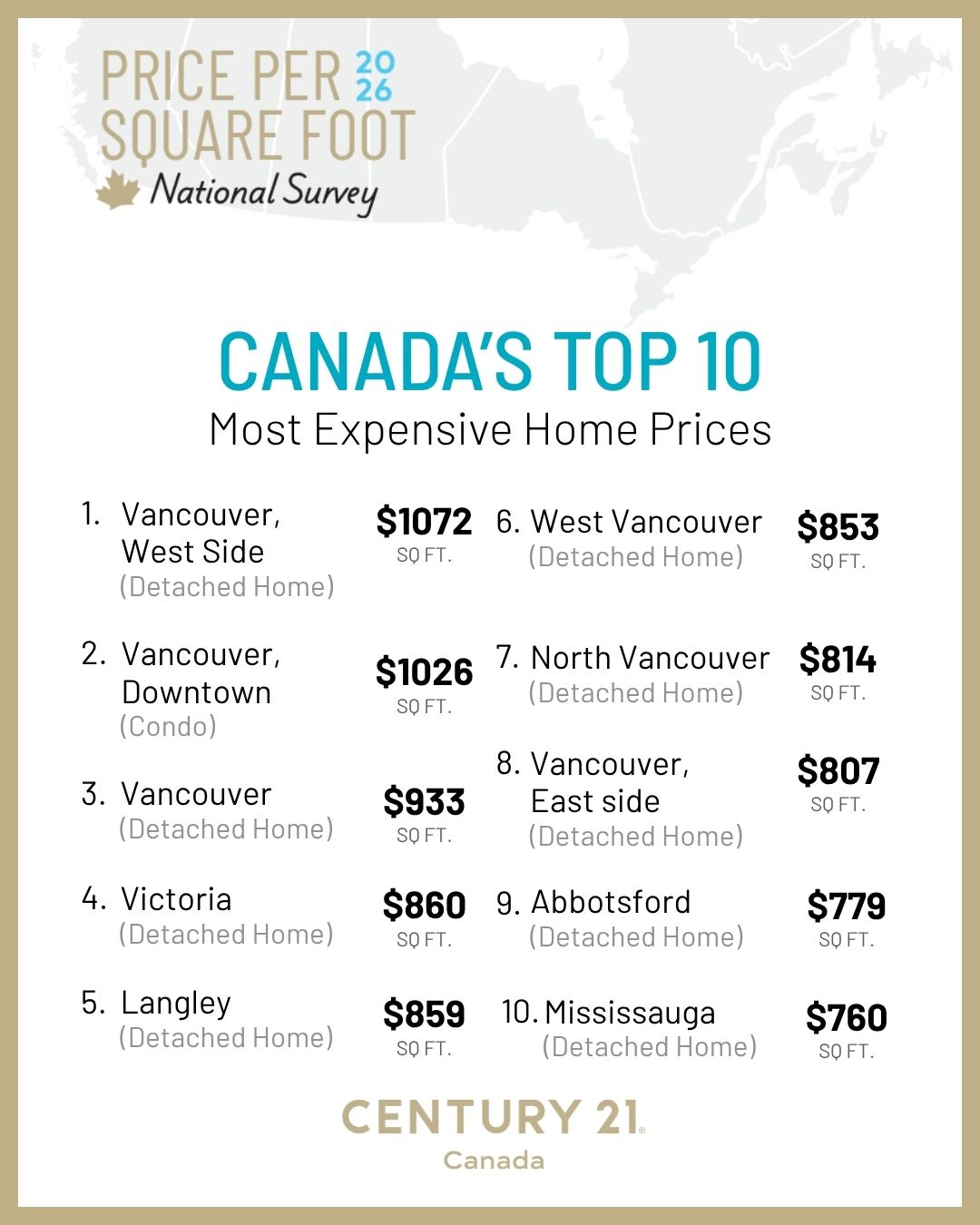
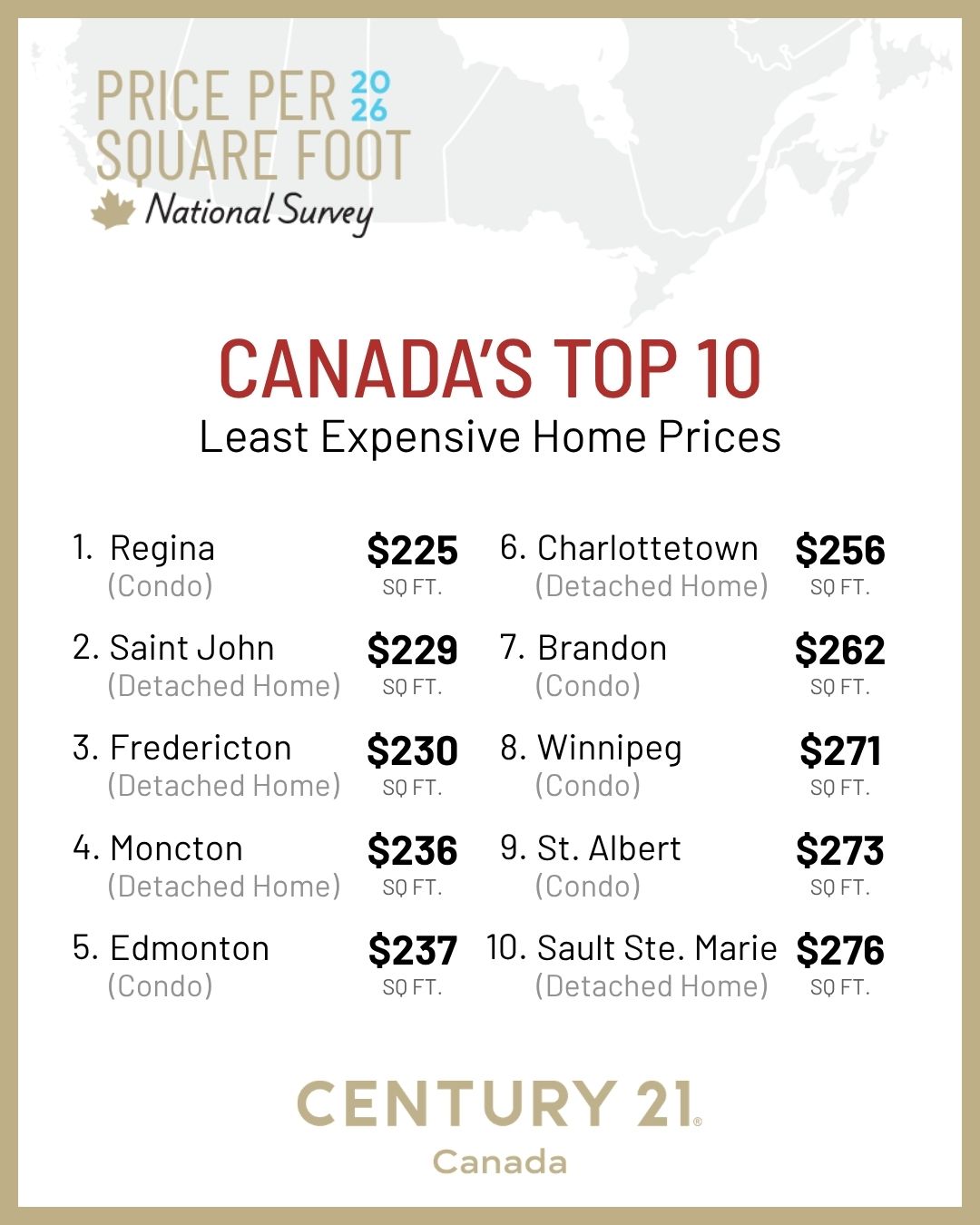
Vancouver (July 28, 2026) – While Canadian home prices declined overall in the first half this year, the story gets widely variable when you look deeper, down to the local level. While Vancouver condo prices declined almost 15 per cent in the first half of the year and Toronto condos almost eight per cent, the price of a detached house in Regina, Saskatchewan, surged 13 per cent – though to a price per square foot still well under half that of a Vancouver or Toronto condo.
CENTURY 21 Canada’s ninth annual Price per Square Foot survey compares the price per square foot of properties sold in 50 communities between January 1 and June 30 this year to the same period of previous years. This year, the survey added the communities of Mississauga in Ontario and Surrey, Abbotsford and Langley in BC.
“While overall the real estate market has been soft this year, Canada’s real estate pricing story is a diverse one and we are seeing significant variation in prices, and price trends, down to the individual neighbourhood,” says Todd Shyiak, Executive Vice President of CENTURY 21 Canada. “The data tells a story of people continuing to move from big city cores in favour of larger communities where you can get more home for your dollar, while pricing in the Prairies and, to a lesser extent, Alberta and Atlantic Canada remain stronger.”
In regions where prices are down overall, a few markets still remain brisk. In BC, for example, some larger markets outside Vancouver proper, like Chilliwack and Kelowna, were steady – though even with substantial price declines Vancouver condos and west side houses remain the most expensive properties in Canada. Toronto and the GTA were down across the board, though Hamilton was up a bit, while declines in Atlantic Canada were modest with Charlottetown showing a slight increase.
A lack of inventory was a key driver of Ontario’s slower market, as people held off putting their homes up for sale.
“Many of our brokers in Ontario are reporting the tightest market most of their agents have seen in their careers,” says Shyiak. “The lack of inventory and uncertainty from buyers as they remain in ‘wait-and-see’ mode are driving a challenging climate. That said, if you look back over a decade, overall prices have trended up over time, which we hope will give consumers confidence to get into the market when they’re ready.”
Regional highlights:
Atlantic Canada
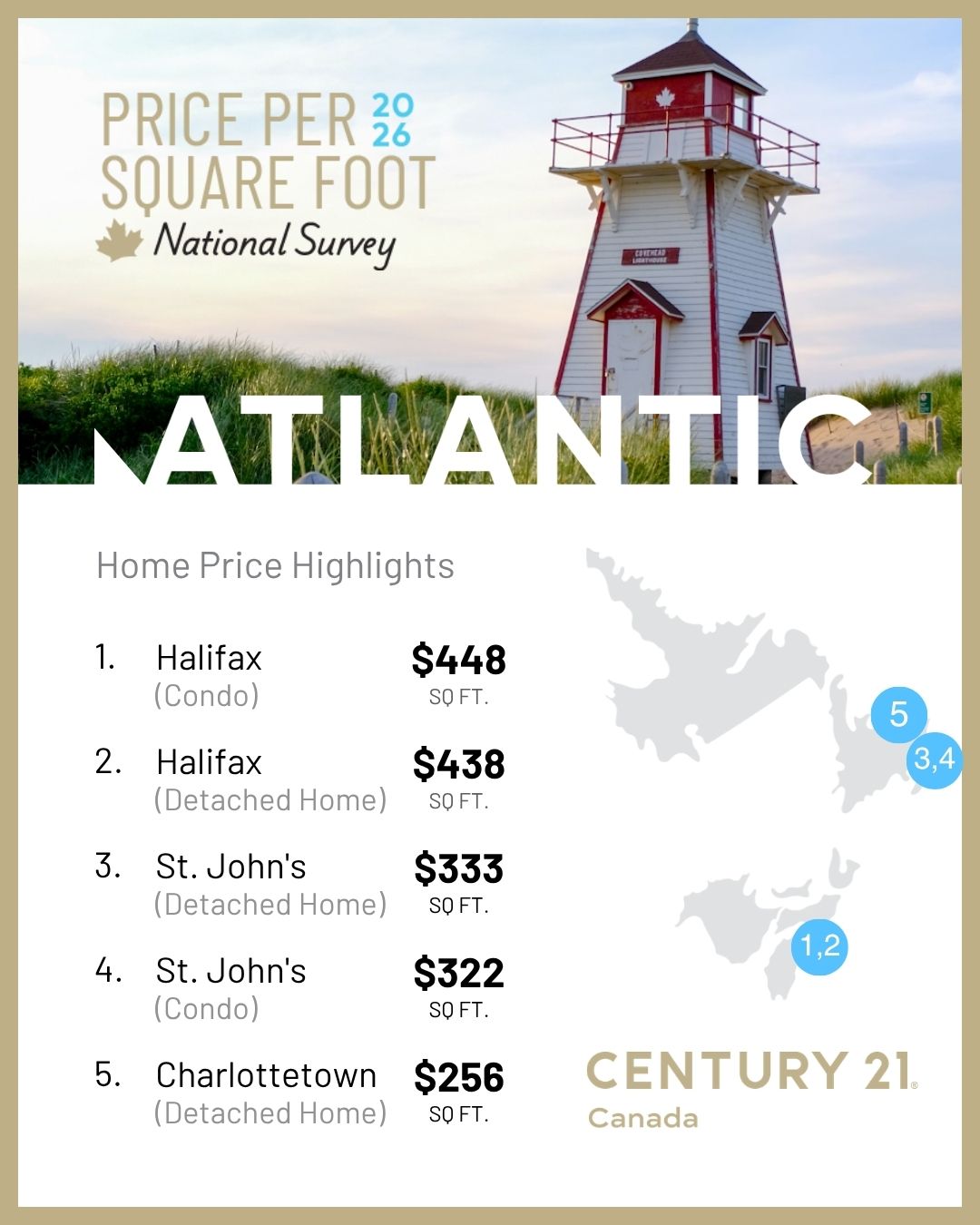
While markets in Atlantic Canada generally saw modest declines this year, with some exceptions, prices were generally stable – a trend consistent with the past few years. All declines stayed under 10 per cent, with small price increases in Charlottetown and Halifax.
“We’re seeing stabilization, but also a little bit of apprehension,” says Joel Ives, owner of CENTURY 21 Colonial Realty in Charlottetown, PEI. “As people are dealing with rising cost of living, not as many buyers are looking to move up from their starter home, and owners in those larger properties aren’t downsizing right now, so we’re sitting at a bit of a stalemate.”
Looking towards the rest of the year, Ives foresees more of the same, though the possibility for pickup isn’t entirely out of the question. “Unless there are some major changes to the economy then I think everyone is sitting back and waiting. But we’ve been through that in the past, when after a bottleneck, everything just goes full tilt again. It’s hard to have a happy medium.”
British Columbia
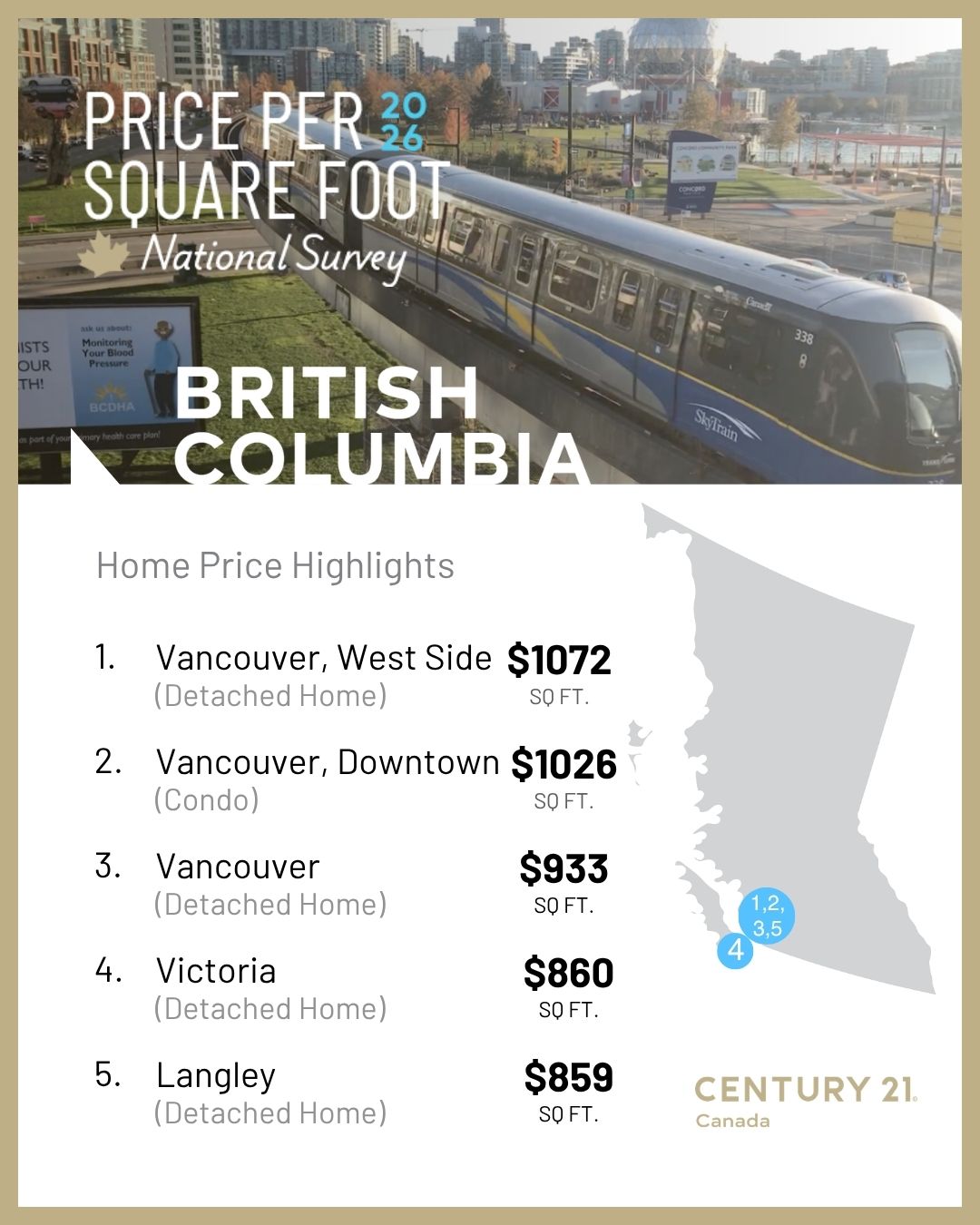
Though BC boasts some of the highest prices per square foot in Canada, the province is not immune to the effects of a slower economy. Uncertain buyers have driven down the prices by nearly 15 per cent in Vancouver’s condo and detached homes market, with nearby suburbs of Richmond, North Vancouver, and White Rock seeing declines of about 10 per cent. That said, these declines follow a few years of steep increases, and generally speaking prices in those communities have returned to pre-pandemic levels.
Some larger communities farther away from the core, such as Kelowna and Chilliwack, however, remained comparatively steady in this year’s period. Prices in Kelowna and Victoria were essentially flat. While prices are down somewhat in Chilliwack, the city’s price stability stands out when compared to Metro Vancouver cities or even among the surrounding communities in the Fraser Valley, which saw drops of up to nine per cent according to external market statistics (not reflected in this year’s survey).
According to local real estate agents, even in markets seeing price declines, good homes that are realistically priced are still moving well.
“What we’re seeing is that good product coming onto the market is still being bought up quickly,” says Rhiannon Foster, agent with CENTURY 21 In-Town Realty, based in Vancouver. “For buyers that have been waiting, this might be the best environment for them – they have choice, they have time to make decisions, they have negotiating power that hasn’t been possible in a very long time.”
The recent government announcement regarding the purchase of unsold condo inventory may not have as big of an impact as one might expect. “The purchase will obviously have an impact on developers and possibly free up some of their capital for other projects,” Foster says. “But for resale buyers, I don’t expect that announcement to dramatically change the market conditions, and the big driver will continue to be affordability.”
Quebec
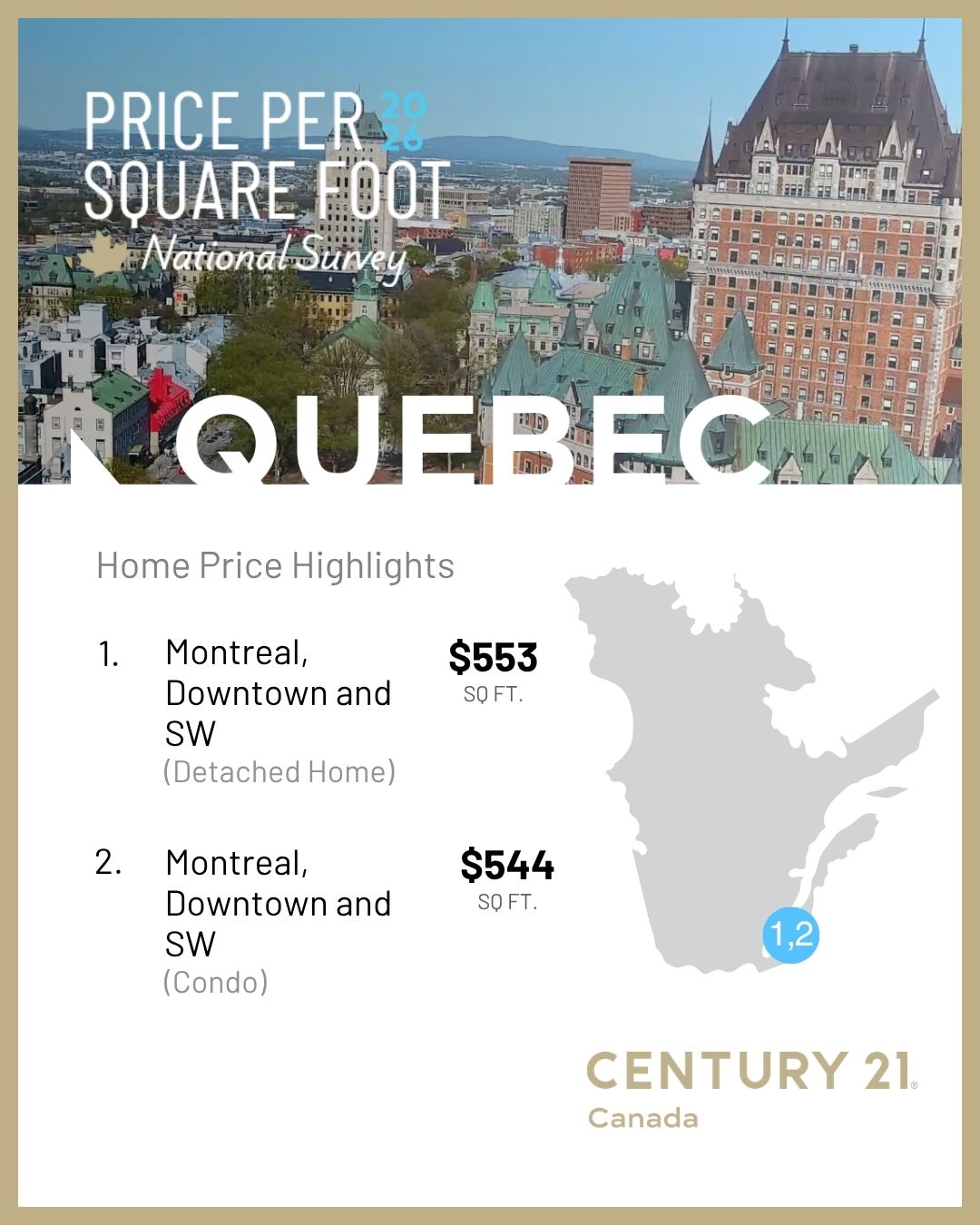
The Island of Montreal has retained its stability after several years of big price jumps. For the first year since the survey began, Montreal condos have seen a dip (albeit very minor). Meanwhile, detached homes have risen nearly six per cent.
Ontario
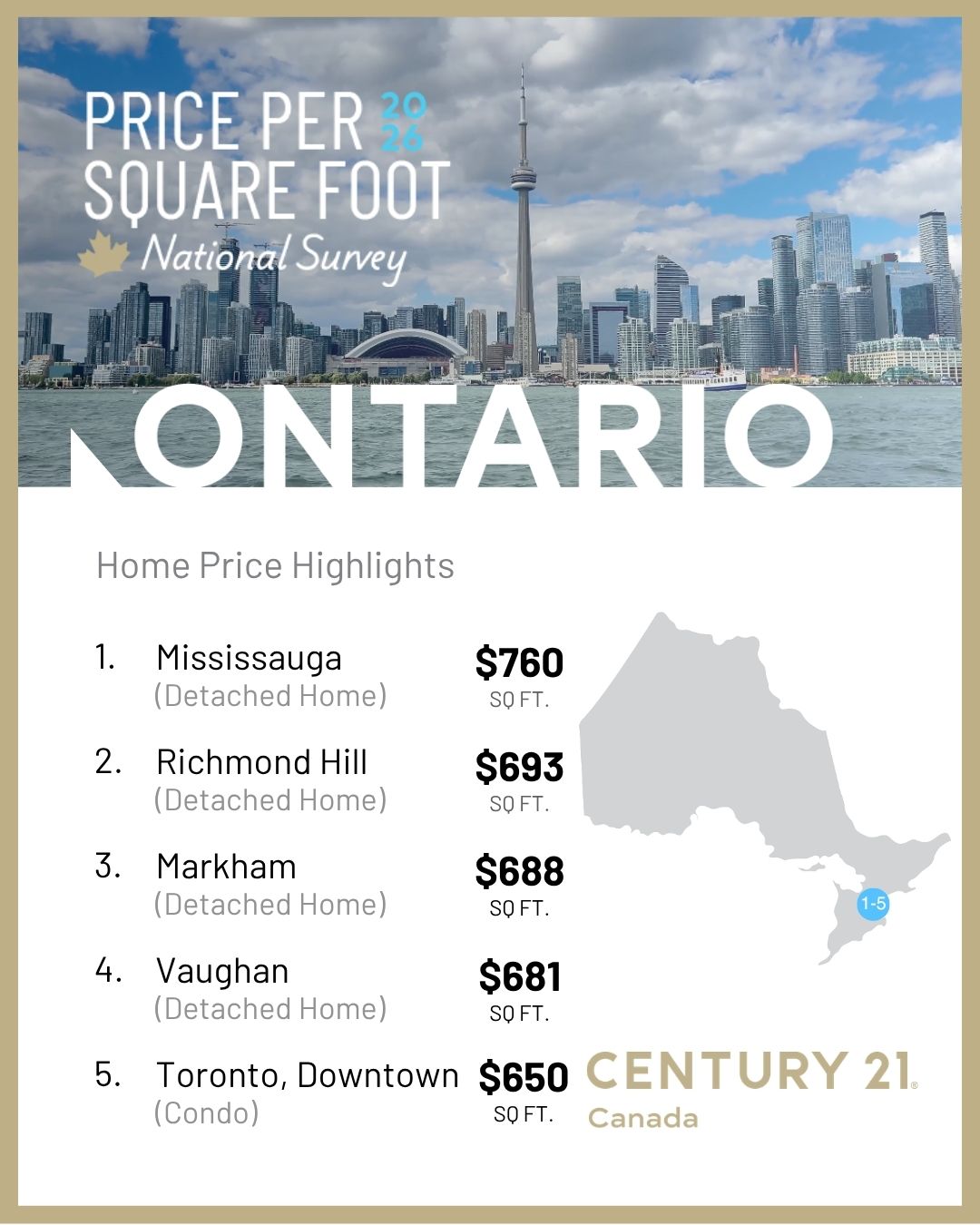
Ontario markets have experienced a difficult first half of 2026, driven primarily by the lack of inventory. Several markets featured in this survey experienced months where no sales occurred at all, and depressed prices across all markets add to very tough conditions for those in the real estate industry in this province.
Nelson Goulart, owner of CENTURY 21 Signature Service in Mississauga, ON, notes that the decline has been steady since 2022. “Real estate has always been driven by economic and political factors. Right now we have two wars happening in the world and tariffs being leveled against Canada. To offset these things, everything we know about how Canada operates has had to change. I believe we’re at the bottom of this market, so even though we’ve been bruised by the start of this year there’s some optimism for the fall markets.”
In Goulart’s own Mississauga (a new addition to the survey this year), detached homes hold one of the highest price points, which speaks to the city’s strengths of proximity and its strong industrial base. “We’re close to Toronto, we have a university campus and Toronto Pearson airport is right here. All together, I think that’s why you see stronger prices in the Mississauga area. We’re the first to be impacted when prices go down, and we’re the first to feel the change when they go up.”
Prairies
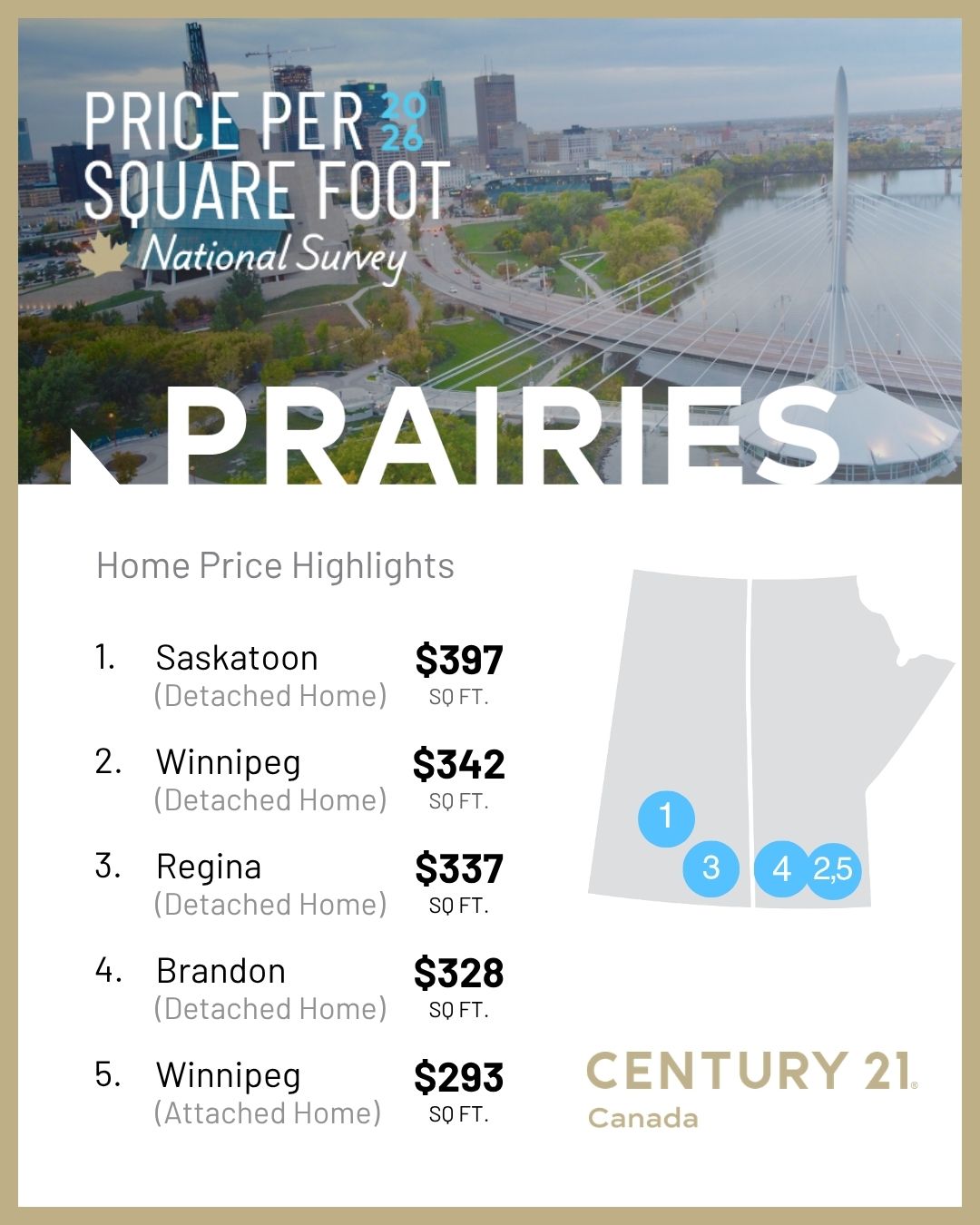
The Prairie provinces have the distinction of the strongest markets in Canada at the moment, continuing a trend of previous years. Detached homes in Regina gained 13 per cent, the highest increase in Canada, with Brandon, Winnipeg and Saskatoon following close behind in that same category. Only condos in Regina and Brandon saw small dips, as buyers continue to take advantage of the pricing and space to search for family homes.
Alberta
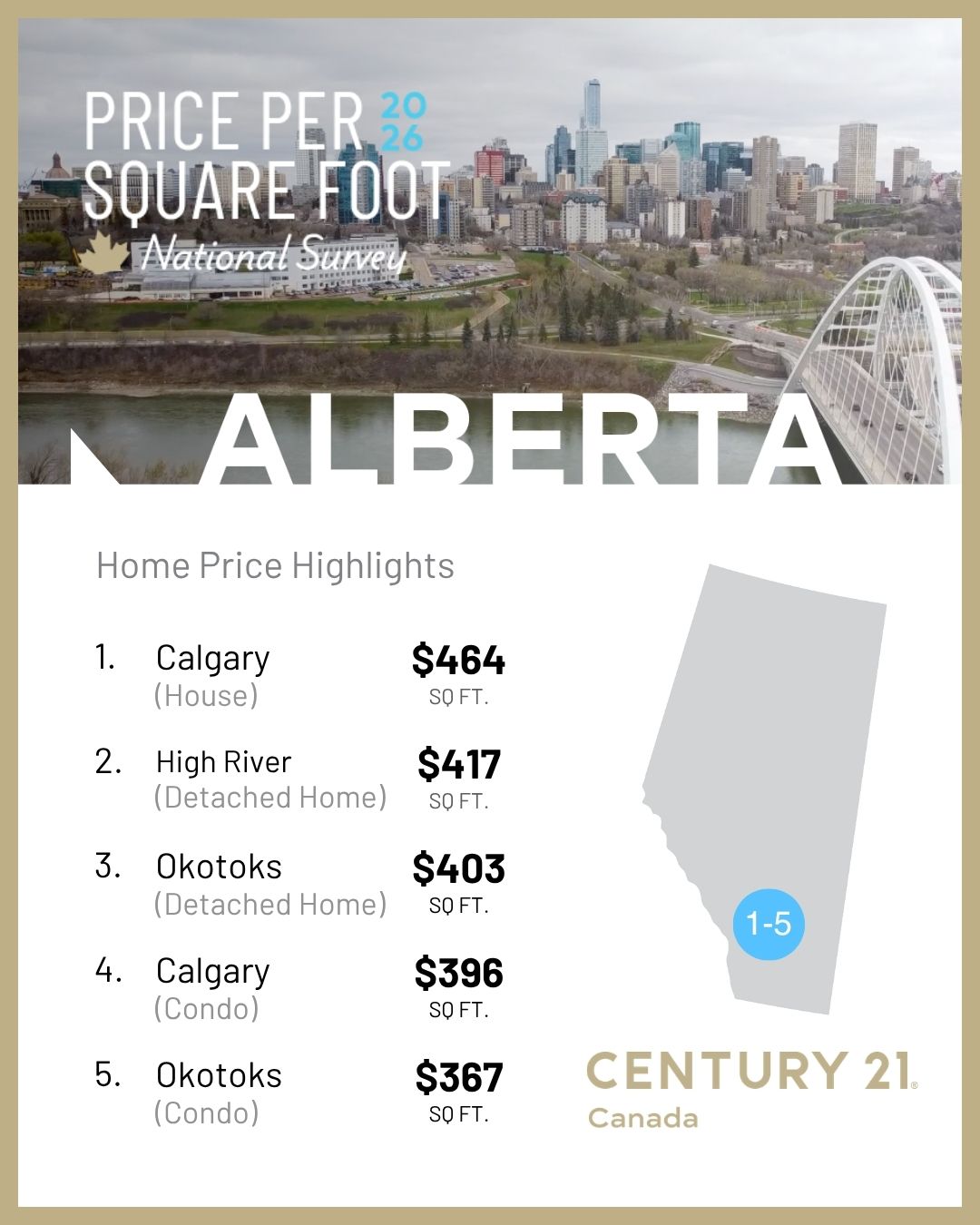
While there were drops to PPSF across Alberta this year (a turnaround from 2025 when it was the only province to rise across the board), they were modest. Markets have held steady in the cities of Calgary and Edmonton, while smaller communities such as Red Deer and St. Albert have seen increases.
“We’ve definitely had a slower start to the selling market,” says Geneva Tetrault, owner of CENTURY 21 Masters in Edmonton, AB. “What’s happened is that we’ve really settled into a balanced market. There are transactions happening, the agents are busy selling, but there’s less of the urgency and panic around every transaction that we’ve seen in the past.”
Tetrault observes that while fringe buyers who may have wanted to jump into a busy market have left, the core group of buyers who are buying and selling their homes based on life events will always be there and now have the opportunity to make those decisions with some breathing room. “There are people who might need a bigger house, who might want to downsize, who are experiencing changes in their families. They will always make up a base of ‘need-oriented’ transactions. The heat of the market may have kept them sitting on the sidelines for a little while, but now we’re seeing them come forward as inventory has had the chance to build up a little again.”
CENTURY 21 Canada’s annual survey of data on the price per square foot (PPSF) of properties gathers and compares sales data from its franchises across Canada from January 1 to June 30 of each year. By looking at the price per square foot at the same time each year the firm is able to get a good idea of how prices have changed over time for similar properties. This year’s survey compares 2025 prices with this year’s results.
Price Per Square Foot Survey Results 2026
| CITY | HOUSE TYPE | 2018 | 2019 | 2020 | 2021 | 2022 | 2023 | 2024 | 2025 | 2026 | % Change from 2025 |
| ALBERTA | |||||||||||
| Calgary | House | $341 | $325 | $320 | $355 | $396 | $419 | $470 | $474 | $464 | -2.11% |
| Calgary | Condo | $329 | $317 | $296 | $303 | $326 | $358 | $421 | $422 | $396 | -6.16% |
| Edmonton | Detached House | $288 | $272 | $268 | $284 | $297 | $309 | $317 | $341 | $344 | 0.88% |
| Edmonton | Duplex | $275 | $256 | $250 | $270 | $287 | $292 | $303 | $316 | $309 | -2.22% |
| Edmonton | Condo | $231 | $220 | $206 | $217 | $222 | $204 | $224 | $241 | $237 | -1.66% |
| High River | Detached House | $193 | $215 | $237 | $271 | $307 | $334 | $382 | $421 | $417 | -0.95% |
| High River | Condo | N/A | $241 | $173 | $176 | $223 | $233 | $285 | $290 | $298 | 2.76% |
| Okotoks | Detached House | N/A | $238 | $254 | $283 | $338 | $362 | $394 | $404 | $403 | -0.25% |
| Okotoks | Condo | N/A | $254 | $211 | $219 | $251 | $288 | $323 | $371 | $367 | -1.08% |
| Red Deer | Detached House | $276 | $262 | $252 | $289 | $293 | $294 | $325 | $359 | $360 | 0.28% |
| Red Deer | Townhouse | N/A | N/A | N/A | $207 | $214 | $226 | $222 | $263 | $282 | 7.22% |
| St. Albert | Detached House | $287 | $271 | $269 | $289 | $322 | $317 | $322 | $349 | $362 | 3.72% |
| St. Albert | Condo | $239 | $223 | $211 | $251 | $238 | $259 | $255 | $273 | $273 | 0.00% |
| St. Albert | Duplex | $262 | $272 | $278 | $280 | $325 | $347 | $301 | $336 | $348 | 3.57% |
| BRITISH COLUMBIA | 2018 | 2019 | 2020 | 2021 | 2022 | 2023 | 2024 | 2025 | 2026 | % Change from 2025 | |
| Chilliwack | Detached House | $432 | $438 | $436 | $570 | $724 | $617 | $635 | $643 | $628 | -2.33% |
| Chilliwack | Townhouse | $325 | $312 | $320 | $406 | $520 | $439 | $468 | $452 | $438 | -3.10% |
| Chilliwack | Condo/ Apartment | $284 | $291 | $283 | $334 | $468 | $429 | $445 | $424 | $456 | 7.55% |
| Kelowna | Detached House | $283 | $274 | $280 | $368 | $463 | $413 | $417 | $408 | $410 | 0.49% |
| Kelowna | Half Duplex | $247 | $260 | $263 | $320 | $402 | $362 | $393 | $366 | $362 | -1.09% |
| Kelowna | Townhouse | $292 | $287 | $302 | $365 | $452 | $422 | $422 | $422 | $395 | -6.40% |
| Kelowna | Apartment | $345 | $348 | $334 | $411 | $526 | $491 | $482 | $467 | $460 | -1.50% |
| Abbotsford | Detached House | $779 | |||||||||
| Langley | Detached House | $859 | |||||||||
| Surrey | Detached House | $660 | |||||||||
| Vancouver | Detached House | $856 | $769 | $816 | $975 | $1,177 | $1,034 | $1,071 | $998 | $933 | -6.51% |
| Vancouver, Downtown | Condo | $856 | $769 | $1,060 | $1,053 | $1,133 | $1,132 | $1,264 | $1,206 | $1,026 | -14.93% |
| Vancouver, East side | Detached House | $721 | $647 | $672 | $877 | $957 | $829 | $977 | $945 | $807 | -14.60% |
| Vancouver, West Side | Detached House | $1,147 | $990 | $1,004 | $1,208 | $1,421 | $1,149 | $1,161 | $1,110 | $1,072 | -3.42% |
| Burnaby | Detached House | $599 | $551 | $579 | $688 | $795 | $879 | $900 | $791 | $712 | -9.99% |
| West Van | Detached House | $899 | $738 | $734 | $971 | $1,038 | $930 | $1,037 | $958 | $853 | -10.96% |
| Vancouver, Richmond | Detached House | $677 | $598 | $608 | $722 | $831 | $773 | $831 | $776 | $698 | -10.05% |
| Delta North | Detached House | $423 | $400 | $413 | $570 | $716 | $594 | $618 | $594 | $546 | -8.08% |
| North Vancouver | Detached House | $681 | $613 | $690 | $794 | $910 | $817 | $937 | $922 | $814 | -11.71% |
| White Rock/South Surrey | Detached House | $506 | $472 | $435 | $625 | $795 | $627 | $724 | $689 | $603 | -12.48% |
| Victoria | Detached House | N/A | N/A | N/A | N/A | $907 | $818 | $818 | $875 | $860 | -1.71% |
| Victoria | Townhouse | N/A | N/A | N/A | N/A | $780 | $645 | $665 | $652 | $630 | -3.37% |
| Victoria | Condo | N/A | N/A | N/A | N/A | $736 | $664 | $672 | $681 | $671 | -1.47% |
| ATLANTIC | 2018 | 2019 | 2020 | 2021 | 2022 | 2023 | 2024 | 2025 | 2026 | % Change from 2025 | |
| Charlottetown | Detached House | $147 | $165 | $178 | $211 | $245 | $235 | $252 | $250 | $256 | 2.40% |
| Fredericton | Detached House | N/A | $99 | $123 | $147 | $170 | $196 | $196 | $248 | $230 | -7.26% |
| Halifax | Detached House | $155 | $162 | $170 | $281 | $408 | $398 | $414 | $436 | $438 | 0.46% |
| Halifax | Condo | $228 | $239 | $270 | $291 | $450 | $467 | $467 | $461 | $448 | -2.82% |
| Moncton | Detached House | $101 | $106 | $124 | $142 | $173 | $197 | $237 | $244 | $236 | -3.28% |
| Saint John | Detached House | N/A | $111 | $123 | $134 | $163 | $192 | $186 | $246 | $229 | -6.91% |
| St. John’s | Detached House | N/A | $132 | $135 | $149 | $167 | $167 | $226 | $340 | $333 | -2.06% |
| St. John’s | Condo | N/A | $174 | $116 | $182 | $212 | $205 | $310 | $353 | $322 | -8.78% |
| PRAIRIES | 2018 | 2019 | 2020 | 2021 | 2022 | 2023 | 2024 | 2025 | 2026 | % Change from 2025 | |
| Regina | Detached House | $254 | $246 | $237 | $250 | $284 | $275 | $290 | $298 | $337 | 13.09% |
| Regina | Condo | $236 | $213 | $205 | $205 | $194 | $189 | $227 | $227 | $225 | -0.88% |
| Saskatoon | Detached House | $270 | $263 | $263 | $314 | $336 | $344 | $370 | $377 | $397 | 5.31% |
| Saskatoon | Condo | $208 | $213 | $217 | $216 | $219 | $226 | $247 | $265 | $288 | 8.68% |
| Winnipeg | Detached House | $282 | $243 | $244 | $293 | $315 | $291 | $302 | $328 | $342 | 4.27% |
| Winnipeg | Condo | $261 | $220 | $223 | $234 | $254 | $249 | $271 | $267 | $271 | 1.50% |
| Winnipeg | Attached | N/A | $202 | $210 | $241 | $269 | $258 | $272 | $288 | $293 | 1.74% |
| Brandon | Detached House | $248 | $246 | $248 | $271 | $276 | $276 | $291 | $299 | $328 | 9.70% |
| Brandon | Condo | $196 | $204 | $204 | $203 | $243 | $236 | $234 | $269 | $262 | -2.60% |
| ONTARIO | 2018 | 2019 | 2020 | 2021 | 2022 | 2023 | 2024 | 2025 | 2026 | % Change from 2025 | |
| Barrie | Detached House | $283 | $350 | $350 | $378 | $503 | $576 | $579 | $600 | $546 | -9.00% |
| Bradford | Detached House | $286 | $345 | $358 | $410 | $580 | $535 | $530 | $569 | $524 | -7.91% |
| Cambridge | Detached House | $332 | $355 | $388 | $450 | $625 | $568 | $568 | $555 | $550 | -0.90% |
| Cambridge | Condo | $344 | $347 | $367 | $435 | $716 | $514 | $530 | $517 | $477 | -7.74% |
| Cambridge | Townhouse | $282 | $317 | $341 | $474 | $616 | $490 | $500 | $519 | $460 | -11.37% |
| Grey Bruce | Detached House | $175 | $182 | $195 | $357 | $659 | $561 | $613 | $541 | $540 | -0.18% |
| Guelph | Detached House | $397 | $409 | $443 | $483 | $690 | $686 | $672 | $668 | $639 | -4.34% |
| Guelph | Condo | $374 | $402 | $423 | $511 | $777 | $601 | $617 | $548 | $505 | -7.85% |
| Guelph | Duplex | $348 | $362 | $400 | $451 | $641 | $557 | $547 | $551 | $501 | -9.07% |
| Guelph | Townhouse | $311 | $335 | $364 | $433 | $510 | $429 | $413 | $391 | $373 | -4.60% |
| Hamilton | Detached House | $362 | $378 | $406 | $532 | $637 | $565 | $444 | $337 | $356 | 5.64% |
| Hamilton | Townhouse | $257 | $350 | $343 | $453 | $478 | $394 | $390 | $432 | $377 | -12.73% |
| Kitchener | Detached House | $339 | $359 | $400 | $430 | $618 | $610 | $605 | $598 | $590 | -1.34% |
| Kitchener | Townhouse | N/A | $323 | $342 | $435 | $576 | $487 | $490 | $470 | $465 | -1.06% |
| Kitchener | Condo | $328 | $362 | $399 | $483 | $800 | $516 | $491 | $446 | $404 | -9.42% |
| London | Detached House | $191 | $237 | $250 | $362 | $602 | $498 | $492 | $498 | $478 | -4.02% |
| Mississauga | Detached House | $760 | |||||||||
| Mississauga | Condo | $542 | |||||||||
| Markham | Detached House | N/A | N/A | $485 | $557 | $685 | $841 | $802 | $751 | $688 | -8.39% |
| Niagara Falls | Detached House | N/A | $275 | $300 | $390 | $531 | $514 | $505 | $503 | $476 | -5.37% |
| Newmarket | Detached House | N/A | $372 | $510 | $505 | $516 | $704 | $695 | $650 | $582 | -10.46% |
| Ottawa | Detached House | $225 | $258 | $313 | $429 | $465 | $587 | $607 | $741 | $639 | -13.77% |
| Ottawa | Townhouse | N/A | N/A | N/A | $392 | $451 | $566 | $534 | $618 | $507 | -17.96% |
| Ottawa | Condo | $442 | $485 | $577 | $479 | $583 | $538 | $550 | $594 | $592 | -0.34% |
| Owen Sound | Detached House | $145 | $158 | $167 | $312 | $380 | $361 | $362 | $391 | $382 | -2.30% |
| Richmond Hill | Detached House | $445 | $465 | $522 | $520 | $665 | $813 | $835 | $768 | $693 | -9.77% |
| Sault Ste. Marie | Detached House | $298 | $306 | $276 | -9.80% | ||||||
| Sault Ste. Marie | Condo | $328 | $296 | $340 | 14.86% | ||||||
| St. Catharines | Detached House | $310 | $290 | $330 | $400 | $612 | $528 | $523 | $567 | $493 | -13.05% |
| Toronto, Downtown | Condo | $903 | $994 | $1,083 | $956 | $792 | $739 | $734 | $705 | $650 | -7.80% |
| Vaughn | Detached House | $434 | $503 | $548 | $612 | $695 | $772 | $791 | $737 | $681 | -7.60% |
| Waterloo | Detached House | N/A | $372 | $407 | $421 | $613 | $603 | $601 | $674 | $642 | -4.75% |
| Waterloo | Townhouse | N/A | $324 | $344 | $408 | $641 | $486 | $489 | $531 | $459 | -13.56% |
| Waterloo | Condo | N/A | $402 | $411 | $503 | $777 | $525 | $498 | $571 | $508 | -11.03% |
| Windsor | Detached House | N/A | $372 | $407 | $295 | $306 | $469 | $364 | $394 | $362 | -8.12% |
| QUEBEC | 2018 | 2019 | 2020 | 2021 | 2022 | 2023 | 2024 | 2025 | 2026 | % Change from 2025 | |
| Montreal, Downtown and SW | Condo | $282 | $289 | $431 | $498 | $456 | $439 | $517 | $545 | $544 | -0.18% |
| Montreal, Downtown and SW | Detached House | $211 | $222 | $366 | $433 | $500 | $467 | $485 | $523 | $553 | 5.74% |
Century 21 Canada affiche une croissance de 39 % au Québec | Century 21 Canada grows 39% in Quebec
Century 21 Canada affiche une croissance de 39 % au Québec
Le Québec constitue un pilier de l’avenir de l’entreprise, qui a ajouté 14 bureaux depuis 2023
MONTRÉAL (17 juin 2026) – Century 21 Canada a enregistré une croissance de 39 % au Québec au cours des trois dernières années et prévoit poursuivre sur cette lancée jusqu’en 2027 et au-delà. Depuis avril 2023, Century 21 Canada a accueilli six nouveaux franchisés et ouvert 14 bureaux dans les régions de l’Outaouais, de la Capitale-Nationale, de la Haute-Yamaska, de l’Abitibi-Témiscamingue, de la Mauricie, de la Montérégie et du Grand Montréal. Grâce à ces nouvelles implantations ainsi qu’à la croissance des opérations existantes, le nombre de courtiers du réseau Century 21 Canada dans la province a augmenté de 39 % durant cette période.
Sébastien Bonnerot est vice-président principal, Croissance stratégique chez Century 21 Canada. Basé chez CENTURY 21 Élite à Gatineau, au Québec, il attribue cette croissance importante à la proposition de valeur de la marque, tant pour les courtiers que pour les consommateurs.
« Notre marque est reconnue partout au pays pour la force de son réseau collaboratif et solidaire, ainsi que pour l’évolution constante des technologies mises à la disposition de nos courtiers afin qu’ils disposent des meilleurs outils pour gérer leur entreprise et accompagner leurs clients, particulièrement les acheteurs d’une première propriété », affirme M. Bonnerot.
Selon lui, le Québec jouera un rôle central dans l’avenir de la marque.
« Nous nous imposons comme un acteur audacieux et perturbateur sur le marché québécois », ajoute-t-il. « Nous n’avons peut-être pas le même nombre de bureaux que certains de nos concurrents, mais notre forte trajectoire de croissance repose sur notre engagement envers un service personnalisé de grande qualité, offert par des courtiers qui connaissent réellement leur communauté. »
Il souligne également que Century 21 Canada, dont le siège social est situé à Vancouver, met à la disposition de ses courtiers plusieurs outils technologiques qui leur permettent d’expliquer clairement et de gérer efficacement tous les aspects d’une transaction immobilière, en français, en anglais et dans plusieurs autres langues. Combinés à l’expertise locale des courtiers, ces outils représentent un avantage considérable. De plus, alors que l’entreprise célèbre son 50e anniversaire, les franchises locales peuvent raconter une histoire profondément canadienne à une époque où de plus en plus de consommateurs choisissent d’encourager les entreprises locales et détenues par des intérêts canadiens.
Chaque année en juillet, Century 21 Canada publie son étude annuelle sur le prix au pied carré, un rapport qui analyse les tendances du prix par pied carré dans des dizaines de collectivités à travers le Canada. L’an dernier, l’étude a révélé que les prix à Montréal poursuivaient leur progression constante après un léger recul observé en 2022 et en 2023, les prix des copropriétés comme ceux des maisons unifamiliales détachées ayant enregistré des hausses à un chiffre. À l’époque, M. Bonnerot avait souligné qu’un nombre croissant de jeunes adultes choisissaient d’acheter une propriété au centre-ville de Montréal, le secteur demeurant attrayant et relativement abordable comparativement à Toronto et Vancouver, où les prix avaient reculé l’an dernier.
Consultez les résultats complets de l’étude sur le prix au pied carré ici.
Pour plus d’information, veuillez contacter:
Damien Campione
Téléphone: (450) 858-2906
Email: damien.campione@century21.ca
À propos de CENTURY 21 Canada®
CENTURY 21 Canada Limited Partnership (https://www.century21.ca) est le franchiseur principal du réseau CENTURY 21® au Canada, détenant l’ensemble des droits de la marque à l’échelle nationale.
Le réseau CENTURY 21 figure parmi les plus importants et les plus reconnus dans le secteur de l’immobilier résidentiel à l’échelle mondiale. Il regroupe environ 11 000 bureaux immobiliers franchisés, détenus et exploités de manière indépendante, ainsi que plus de 129 500 professionnels de l’immobilier dans le monde.
Présent dans 80 pays et territoires, CENTURY 21 accompagne ses membres grâce à des outils technologiques de pointe, des solutions marketing performantes, de la formation continue, ainsi qu’un soutien en gestion et en administration — le tout pour les aider à offrir un service exceptionnel à leurs clients.
Century 21 Canada grows 39% in Quebec
Quebec a foundation of the firm’s future, as it adds 14 new offices since 2023
MONTRÉAL (June 17, 2026) – Century 21 Canada has grown 39 per cent in Quebec in the last three years, and plans to extend that growth through 2027 and beyond. Since April 2023 Century 21 Canada has added 6 new franchisees and 14 offices in Outaouais, Capitale Nationale, Haute Yamaska, Abitibi-Temiscamingue, Mauricie, Montérégie, and Grand Montréal. With the new offices plus growth at existing operations, the number of Century 21 Canada brokers in the province has grown 39 per cent in that time.
Sébastien Bonnerot is Century 21 Canada’s Senior Vice President of Strategic Growth, and based at CENTURY 21 Élite in Gatineau, Québec. He credits the brand’s value proposition for both agents and consumers for this significant growth in the province.
“Our brand is known across the country for its close-knit, collaborative network as well as continually evolving the technology available to our brokers to ensure they have the best tools to run their business and serve clients, especially first-time homebuyers,” Bonnerot says.
Quebec will play a central role in that brand into the future, he adds.
“We are emerging as a bold, disruptive player in the province,” he says. “We may not have the big number of offices our competitors do, but we are on a strong growth trajectory due to our focus on great, individual service by brokers who really understand their communities.”
He added Century 21 Canada, headquartered in Vancouver, offers several tech tools brokers can use to clearly explain and handle all the details of a real estate transaction – in French, English, and a number of other languages. When paired with sales representative’s local knowledge it makes for a powerful tool. Furthermore, with the company celebrating its 50th anniversary, local franchises have a very Canadian story to tell as more consumers work to support local and Canadian-owned companies.
Every July Century 21 Canada releases its annual price per square foot survey – a report on trends in pricing, per square foot, in dozens of communities across Canada. Last year, the report found prices in Montreal continued a steady upward trend after a modest decline in 2022 and 2023, with both condo and detached house prices rising in the single figures. At the time, Bonnerot noted a larger number of younger adults were buying homes downtown, as the area remains attractive and relatively affordable vs. Toronto and Vancouver – which both saw price declines last year.
See full price per square foot study results here.
-ENDS-
About CENTURY 21 Canada®
CENTURY 21 Canada Limited Partnership (century21.ca) is a real estate master franchisor with complete rights to the CENTURY 21® brand in Canada.
The CENTURY 21 System is one of the world’s largest and most recognized residential real estate franchise sales organization with approximately 11,000 independently owned and operated franchised real estate offices worldwide and over 129,500 sales professionals. CENTURY 21 provides comprehensive technology, marketing, training, management, and administrative support for its members in 80 countries and territories worldwide.
CENTURY 21 Lanthorn Expands into Kingston to continue growth in Eastern Ontario

Kingston, ON –May 2026 – CENTURY 21 Lanthorn Real Estate is proud to announce its expansion into Kingston through the alignment of the agents formerly operating as CENTURY 21 Champ. The transition marks an exciting new chapter for the CENTURY 21 Canada brand in the region while recognizing the retirement of longtime brokerage owner Greg Enright following 44 years with the network.
The move brings together two established C21 Canada brokerages under a shared commitment to growth, collaboration, and community service. CENTURY 21 Lanthorn, now celebrating 45 years with the CENTURY 21 Canada network, has built a strong presence across Eastern Ontario with offices spanning the 401 corridor and beyond.
“We’re excited to continue evolving and growing our brokerage while remaining deeply rooted in the communities we serve,” said Joelle Briggs, Broker of CENTURY 21 Lanthorn. “Kingston is an important market, and this evolution allows us to strengthen the support we provide to agents and clients alike. Our focus has always been on building something collaborative, because what makes us strong is not just individual agents working independently, but a connected team that contributes to something larger.”
The Kingston office will operate from CENTURY 21 Lanthorn’s recently opened West End location at 745 Bayridge Drive. Approximately 10 agents joining the brokerage through the transition will now have access to the expanded operational support, collaborative culture, and regional network that CENTURY 21 Lanthorn has developed over decades in business.
“Our goal is sustainable growth built on a strong foundation,” Briggs added. “We want to continue adding the right people, the type of agents who are engaged in their communities, who want to collaborate, and who care deeply about delivering exceptional service to clients. Real estate continues to evolve, and our responsibility as a brokerage is to evolve with it.”
Briggs also acknowledged Greg Enright’s longstanding contribution to the CENTURY 21 brand in Kingston.
“Greg has been part of the CENTURY 21 family for many years, and we sincerely wish him all the best in retirement,” said Briggs. “We’re grateful for the foundation he helped build in Kingston and look forward to continuing that presence in the community under the CENTURY 21 banner.”
The transition reflects CENTURY 21 Canada’s continued focus on supporting brokerages that are investing in long-term growth, agent development, and modern brokerage leadership.
“CENTURY 21 Lanthorn has demonstrated what sustained success looks like through collaboration, innovation, and strong leadership,” said Todd Shyiak, Executive Vice President of CENTURY 21 Canada. “What makes our brand stand out in this industry is our culture of collaboration and human support. Joelle and her team exemplify that and keep their focus supporting agents who in turn give their all to their clients, all while staying connected to the communities they serve. We’re excited to see that approach continue to grow in Kingston.”
CENTURY 21 Lanthorn now operates six locations throughout Eastern Ontario, including offices in Trenton, Belleville, Napanee, Kingston, and surrounding communities.
About CENTURY 21 Canada™
Century 21 Canada Limited Partnership (century21.ca) is a real estate master franchisor with complete rights to the CENTURY 21® brand in Canada.
The CENTURY 21 System is one of the world’s largest residential real estate brokerage franchisors, with approximately 13,000 franchise offices and more than 145,000 independent sales associates located in 86 countries and territories.
Independently Owned and Operated. ®/™ trademarks owned by Century 21 Real Estate LLC used under license or authorized sub-license. ©2026 Century 21 Canada Limited Partnership.
The trademarks REALTOR®, REALTORS® and the REALTOR® logo are controlled by The Canadian Real Estate Association (CREA) and identify real estate professionals who are members of CREA. Used under license.
Media contact
Lauren MacFarland
CENTURY 21 Canada
Lauren.MacFarland@century21.ca
604-606-215,
About CENTURY 21 Canada™
Century 21 Canada Limited Partnership (century21.ca) is a real estate master franchisor with complete rights to the CENTURY 21® brand in Canada.
The CENTURY 21 System is one of the world’s largest residential real estate brokerage franchisors, CENTURY 21 has approximately 13,000 franchise offices and more than 145,000 independent sales associates located in 86 countries and territories.
Independently Owned and Operated. ®/™ trademarks owned by Century 21 Real Estate LLC used under license or authorized sub-license. ©2024 Century 21 Canada Limited Partnership.
The trademarks REALTOR®, REALTORS® and the REALTOR® logo are controlled by The Canadian Real Estate Association (CREA) and identify real estate professionals who are members of CREA. Used under license.
###
Century 21 Sun Country Realty acquires Interlake Real Estate

Vancouver – May 1, 2026 – Brokerage owners Reg and Myrna Black of Century 21 Sun Country Realty Brokerage in Beausejour, MB, are thrilled to announce that they have acquired Interlake Real Estate which includes 2 brokers, 11 agents, 2 admin staff and the two offices in Selkirk and Gimli. Interlake Real Estate is a well-established brokerage in the Interlake area that was incorporated by Richard Arnason in 1964.
“Mr. Arnason created a very successful insurance and real estate office in Gimli” said
Reg Black, the Broker of Century 21 Sun Country Realty. “He sold the business a few
years ago and the insurance division is now known as Brio Insurance. The real estate
division will now be known as Century 21 Sun Country Realty.”
Century 21 Sun Country Realty originally started as an independent office in 1984. It became affiliated with CENTURY 21 Canada in 1997, and the Blacks have owned the company since August of 2005. Their office is located in Beausejour and has 13 agents that primarily serve Eastern Manitoba and Winnipeg.
“As a Brokerage, we are always looking for ways to grow our office. We have explored other acquisitions in the past, but this one really is a great fit. The agents from Interlake Real Estate are experienced professionals, the admin are fantastic and we look forward to working with all of them” offered Myrna.
The seed for an acquisition was planted a few years again when Reg contacted a representative of Access Credit Union when it acquired Interlake Real Estate through an amalgamation with Noventis Credit Union in the summer of 2022. “I just sent my contact a note and said if they would ever be looking to divest themselves of the real estate office to reach out. And here we are.”
The Blacks realize that the name change is significant. But they have experience on their side having experienced this firsthand when the independent office Reg was working for acquired a Century 21 franchise. “I lived through a brokerage name change so fully appreciate what the 13 agents of Interlake Real estate are having to go through. We will be collaborating with them to create awareness of the change throughout the region.”
All 13 agents made the choice to come onboard with CENTURY 21 Sun Country, which Reg attributes to the culture their office has worked so hard to build and the strong value proposition that CENTURY 21 Canada provides. “Besides the tools, they’re seeing that we are committed to upholding a culture that champions agents. Our priority is giving them a strong foundation of support so that they know we’re behind them every step of the way as they make this transition.”
Jared, their son and Associate Broker also offered that their goal was to make the transition as seamless as possible. “Other than the rebranding – nothing changes. We are keeping the office locations, fixtures, and equipment. We are keeping the same phone numbers. And most importantly – we are keeping all the agents and staff.”
Those agents and administrators now have access to the wealth of tools but more importantly, the power of the legacy brand, now celebrating it’s 50th year. “CENTURY 21 Sun Country is going to be the best home for these new agents because of Reg, Myrna and Jared’s leadership,” says Todd Shyiak, Executive Vice President of CENTURY 21 Canada. ”They’re going to feel the personal support that is the trademark of all our brokers, and the power of our national network – from referrals to recognition, there’s so much we offer as one of the leading real estate brands worldwide, and we can’t wait to see how they chart this new chapter in their careers.
“The response we have received from everyone at Interlake – beyond the initial shock – has been very positive. They are excited to learn about everything we can offer to not only maintain their business but grow it,” said Reg. “Collectively we are local. And we will remain local. With our existing office and these two new locations all our agents will be able to help buyers and sellers in Selkirk, Interlake, Eastman, and Winnipeg with all their real estate needs. Really looking forward to this!.”
Media contact
Lauren MacFarland
CENTURY 21 Canada
Lauren.MacFarland@century21.ca
604-606-215,
About CENTURY 21 Canada™
Century 21 Canada Limited Partnership (century21.ca) is a real estate master franchisor with complete rights to the CENTURY 21® brand in Canada.
The CENTURY 21 System is one of the world’s largest residential real estate brokerage franchisors, CENTURY 21 has approximately 13,000 franchise offices and more than 145,000 independent sales associates located in 86 countries and territories.
Independently Owned and Operated. ®/™ trademarks owned by Century 21 Real Estate LLC used under license or authorized sub-license. ©2024 Century 21 Canada Limited Partnership.
The trademarks REALTOR®, REALTORS® and the REALTOR® logo are controlled by The Canadian Real Estate Association (CREA) and identify real estate professionals who are members of CREA. Used under license.
###
The great Canadian housing gap – 55 per cent of Canadians say they’re not living in their ideal home

VIEW OUR FULL SURVEY RESULTS
The great Canadian housing gap – 55 per cent of Canadians say they’re not living in their ideal home
New study by Century 21 Canada and Ipsos finds Canadians want more space – on average about 2,100 square feet, 3 bedrooms, 2.5 baths
Vancouver, BC (March 26, 2026) – An Ipsos study conducted for Century 21 Canada has found 55 per cent of Canadians are not living in their ideal home. Most (63 per cent) want more space, and well over half (59 per cent) say their ideal home is a single detached house.
On average, Canadians would like 2,098 square feet, three bedrooms, and 2.5 bathrooms. Along with size and condition, neighborhood and a bigger yard ranked highly as factors in an ideal home. While 13 per cent of Canadians live in a home under 500 square feet only 4 per cent say that is the ideal size for them.
However, not surprisingly more than half of respondents said affordability is a barrier to getting into their ideal home. That said, 19 per cent said they are at least somewhat likely to buy a new home in the next year – and 55 per cent of those would be first-time buyers. On average, those likely to purchase a home in the next year have a budget of $677,000 which, according to Statistics Canada, is just shy of the average house price of $698,881.
“The Canadian dream of owning a moderate stand-alone house with a few bedrooms for family and a yard is as relevant today as it ever has been,” says Todd Shyiak, Executive Vice President of CENTURY 21 Canada. “Of course, the results are broadly diverse and available housing must reflect that. However, the majority of Canadians today want a house with about three bedrooms and a yard. This perhaps speaks to why many moderately-priced communities just outside metro centres are experiencing a real estate boom.”
Also, those who own their own homes are significantly more likely to report their living situation is ideal or close to ideal than renters.
“What struck me in the results is the satisfaction gap between owners and renters,” says Sean Simpson, Senior Vice President of Ipsos Public Affairs. “Eighty per cent of homeowners say they love their home and it’s perfect for them, compared to just 50 per cent of renters. That 30-point gap helps explain why homeownership remains the goal for most Canadians – it’s not just about building equity, it’s about finding a place that truly feels like home.”
Study highlights:
Current living situation:
- 45 per cent report their current living situation is ideal or very close to ideal. 55 per cent report their living situation is less than ideal. Owners are more likely to view their situation as ideal than renters.
- 54 per cent own their home, while 37 per cent rent. 5 per cent live rent-free with family, 2 per cent pay rent to family, and 1 per cent live in some other situation.
- 13 per cent of Canadians live in a home of less than 500 square feet, but only 4 per cent report that is the ideal size for them. By contrast, only 8 per cent of Canadians report living in a home of more than 3,000 square feet, but 19 per cent would find that the ideal size.
- 51 per cent currently live in a single detached house, while 59 per cent say that is their ideal living situation – a gap of 8 percentage points. By contrast, 16 per cent of Canadians live in a low-rise condo or apartment but only 12 per cent say that is their ideal living situation.
What Canadians want in their ideal home:
- When asked whether their current space is the ideal size, 63 per cent say they would like more space, Younger Canadians (18 – 34) are most likely to want more space (76 per cent), though almost half (45 per cent) of those aged 55+ would like more space and just 19 per cent less space.
- On average, people want a home that is 2,098 square feet – about 600 square feet larger than the average size of a home (1,470 square feet) identified in the report.
- When asked about bedrooms, 41 per cent said three bedrooms would be ideal for them. 25 per cent said two bedrooms is ideal, and 24 per cent want four bedrooms.
- Similarly, when asked about the ideal number of bathrooms the average was 2.5 – a home with one or five bathrooms both ranked low.
- Other than price, the top factors when choosing an ideal home to purchase include condition of the home (40 per cent), location/neighborhood (38 per cent), space for family/pets (32 per cent), and a yard (29 per cent).
- When presented with a list of factors and asked to select which would make their living situation more ideal respondents chose:
- more space
- bigger yard or garden
- less pkeep and maintenance
- owning instead of renting
- the ability to walk to restaurants and shops.
Barriers to living in your ideal home:
- The top barrier to living in the ideal home is price, at 59 per cent, followed by the cost and difficulty of moving (34 per cent), and saving for a downpayment (14 per cent).
- 19 per cent said they are likely to buy a home in the next year. Of those, 55 per cent said they would be first-time homebuyers.
- Among likely buyers the average budget is $676,731. 25 per cent said their budget is under $300,000, just 16 per cent more than $1 million.
Ipsos conducted the survey for Century 21 Canada online between February 6 and 10, via the Ipsos I-Say Panel. A representative sample of 2,300 Canadians ages 18+ was interviewed. The data and regional representation was weighted according to Statistics Canada census data to ensure it accurately reflects the population of Canada. The results are considered accurate to within +/- 2.5 percentage points.
-ENDS-
For more information please contact:
Shawn Hall
Century 21 Canada
Phone: (604) 619-7913
Email:
About CENTURY 21 Canada®
CENTURY 21 Canada Limited Partnership (century21.ca) is a real estate master franchisor with complete rights to the CENTURY 21® brand in Canada.
The CENTURY 21 System is one of the world’s largest and most recognized residential real estate franchise sales organization with approximately 11,000 independently owned and operated franchised real estate offices worldwide and over 125,000 sales professionals. CENTURY 21 provides comprehensive technology, marketing, training, management, and administrative support for its members in 79 countries and territories worldwide.
Price Per Square Foot Survey 2025
Biggest cities see biggest price drops as Canadian homebuyers react to economic uncertainty
Annual Price per Square Foot survey looks at prices back to 2018 for almost 50 Canadian communities – finds condo prices in metro markets dip while smaller Prairie and Atlantic communities shoot up
Vancouver (July 28, 2025) – Century 21 Canada’s annual Price per Square Foot survey reveals Canada has no one real estate story. The often talked about major urban markets of the GTA and Greater Vancouver area have seen price declines and, across the board, sales volumes have declined this year.
But less talked about is the contrast seen in some smaller communities in Atlantic Canada, Alberta, and the Prairies, where prices are up 10 – 30 per cent this year – but to rates still far below those in other metro centers.
The annual survey compares the price per square foot of properties sold in almost 50 communities, large and small and in every province, between January 1 and June 30 this year to the same period of previous years. In many cases, it has data going back to 2018 for both metro centers and smaller communities.
“We’ve seen huge variations in pricing trends in the first half of 2025, as people in different communities adjust to headlines and the uncertainty caused by the tariff situation in different ways,” says Todd Shyiak, Executive Vice President of CENTURY 21 Canada. “The GTA is seeing the toughest market in years, while we’re seeing price strength in some Alberta, Saskatchewan, Manitoba, and Atlantic Canada communities. Anecdotally, we are hearing from agents that many clients are seeking livable communities with lower real estate prices this year, continuing a trend we started seeing during the pandemic.”
He adds the survey looks at pricing trends over several years across Canada, and that this year the pricing data needs to be taken in context of overall sales volumes slowing due to economic uncertainty.
“That said, there are early signs the market became somewhat more active in June, at the end of our survey period, but overall we anticipate a “wait and see” approach from many prospective buyers and sellers for the rest of the year,” Shyiak says.
According to this year’s data Alberta, Saskatchewan, and Manitoba saw a continuation of past year’s upward price per square foot trends, indicating a sustained interest in the relatively affordable homes of the Prairie region. In that region larger markets generally saw smaller increases, even a few nominal declines, while mid-sized markets such as Red Deer, AB and Brandon, MB saw double-digit rises.
The steepest increases across the country were in the Atlantic region, with New Brunswick seeing a big price per square foot increase for detached homes in Fredericton and St. John. Elsewhere in Atlantic Canada, home prices by square foot decreased in St. John’s, NL, but remained on par with 2021 – 2022 benchmarks.
In the major city condo markets, the GTA experienced notable decreases, with most markets dipping to prices in line with those in 2022 and downtown Toronto dipping to the lowest level since 2018. Detached homes in the GTA have not been exempted, with Hamilton houses seeing the biggest percentage decrease in the region at 24 per cent. On the west coast, downtown Vancouver condos decreased in price a modest amount, though overall Metro Vancouver prices stepped back to about 2020 – 2021 levels as suburban house prices declined.
Notably, the sales volume in many metropolitan areas trended downward for the first half of this year, likely due to economic uncertainty caused by the tariffs imposed by the US, though many real estate boards report signs of an uptick going into the second half of the year.
Regional highlights:
Atlantic Canada
Markets in Atlantic Canada have been strong this year, especially in the New Brunswick region with Fredericton and St. John both seeing double-digit jumps in their detached home prices per square foot – still to levels below those in most other regions of Canada. Other markets saw more modest gains, and small dips can be observed in Halifax condos and Charlottetown detached homes. However, Halifax retained the jump in pricing seen after the 2021-2022 surge and Charlottetown remains above its 2023 benchmark, though remains one of the most affordable regions in the country.
“It’s definitely been a strong year,” says Krista Trask, agent with CENTURY 21 Sellers Choice in St. John’s, NL. “We’ve been kept busy and we’re seeing a lot of people who are more interested in moving here due to how affordable St. John’s is when compared to the rest of the country.”
“It was a little bit of a slow start in the first quarter, but June had strong numbers,” says Joel Ives with CENTURY 21 Colonial Realty in Charlottetown, PEI. “We had such an increase in the past five years that this year might have pumped the brakes a little and now our market has settled.”
British Columbia
After years of steady upward price growth, BC is seeing the effects of uncertain buyers as both prices and sales volumes dropped. In most cases price declines have been moderate, though detached homes in Burnaby dropped 12 per cent to $791 per square foot and townhouses in Victoria were down 13 per cent to $392 per square foot. Current prices in both cases are still above 2021 levels, after steep increases in 2022 and 2023. In Chilliwack prices have cooled and remained steady after substantial gains since 2020.
In BC’s interior, the pattern of steady pricing continues, with moderate losses and gains. Kelowna saw losses between two to six per cent in all housing types except townhomes, which held steady. As buyers look for cheaper alternatives to the Greater Vancouver area, they might have to go farther outfield – new to the survey this year is Kitimat, which has the lowest PPSF in the country, with townhomes going for $168 per square foot.
Rhiannon Foster, an agent with CENTURY 21 In Town in Vancouver, BC, notes that this year has been a rollercoaster for buyers and sellers in the Lower Mainland. “We started off strong this year, but then came the complications from the tariffs and we saw a pause happen,” she explains. “In my experience, sellers are holding to their prices because they don’t have to sell immediately.
Right now, what I’m seeing is that sales are starting to pick up but we’re about to go into August, when real estate is not a top priority for people. So we’ll see a slowdown over the next few weeks no matter what, but we do expect a lot of inventory to come back in September. If there are sellers waiting, they’ll have competition then.”
Quebec
The price per square foot increases in the Montreal market of years past have continued on an upward trend, with condo prices rising 5 per cent to about the same level as they were in 2022, while detached house prices rose almost eight per cent.
Sebastien Bonnerot, Vice President of CENTURY 21 Quebec in Gatineau, Quebec notes that the price trends in Montreal have settled into a comfortable spot for future growth. “We’re not seeing the big jumps in prices that we saw four to five years ago, but we’ve also moved past that short period of decline that happened around 2023. The market in the Montreal area is strong, we have a lot of young buyers who want a city lifestyle and like the culture and affordability that Montreal has to offer, compared to markets in Ontario.”
Ontario
Ontario, more than any other region of the country, is feeling the most negative effects of the uncertain economic conditions. Condo and house prices in most GTA markets are down, most notably in Toronto proper, where condo prices dipped almost 12 per cent, and in Markham, where detached home prices dropped 22 percent.
Outside of the GTA, pricing changes were more moderate and mixed, with Ottawa emerging as a more popular market and seeing price increases – 22 per cent up for detached houses.
Nelson Goulart, with CENTURY 21 Signature Service, sees how buyers and sellers have hesitated to jump into the market. “They tend to take a position of ‘wait and see,’ similar to the 90’s. There are different factors now, but they’re concerned about qualifying at higher interest rates and once that uncertainly lifts, that’s when they’ll jump in.
“The market has perked up in the last few weeks, and at the end of the day, uncertainty will pass. There may be opportunity now to buy at reduced rates as long as people are looking for long-term investments and looking at the ‘why’ of their decision to purchase a home.”
Prairies
Overall, prices in the prairies were strong compared to the rest of the country. Only condos in Winnipeg fell in price, and then by just 1.5 per cent, while condos in Brandon, Manitoba saw the highest increases – riding 22 per cent in price per square foot. The relative affordability of this region continues to draw buyers looking for more value for their dollar.
Gary Busch, from CENTURY 21 Fusion in Saskatoon, Saskatchewan, notes that his province is the tortoise in the race – no huge changes, but steadily moving forward. “We’re probably going to see a big jump next year,” he notes. “We have jobs, and immigration both from within and outside of Canada. The people who come here are all skilled workers with above-average jobs, with good wages, so we’re building houses as fast as we can, and we have the advantage of still being affordable.”
Alberta
Alberta holds the distinction of being the only region that saw no drops in price per square foot, continuing a strong market trend observed in recent years. There are signs that some of the fervor around Calgary may have cooled – prices rose by less than one per cent – but smaller towns such as High River, Okotoks and Red Deer continued to see increases.
CENTURY 21 Canada’s annual survey of data on the price per square foot (PPSF) of properties gathers and compares sales data from its franchises across Canada from January 1 to June 30 of each year. By looking at the price per square foot at the same time each year the firm is able to get a good idea of how prices have changed over time for similar properties. This year’s survey compares 2024 prices with this year’s results.
Price Per Square Foot Survey Results 2025
| ALBERTA | 2018 | 2019 | 2020 | 2021 | 2022 | 2023 | 2024 | % Change from 2024 | ||
| Calgary | House | $341 | $325 | $320 | $355 | $396 | $419 | $470 | $474 | 0.85% |
| Calgary | Condo | $329 | $317 | $296 | $303 | $326 | $358 | $421 | $422 | 0.24% |
| Edmonton | Detached House | $288 | $272 | $268 | $284 | $297 | $309 | $317 | $341 | 7.57% |
| Edmonton | Duplex | $275 | $256 | $250 | $270 | $287 | $292 | $303 | $316 | 4.29% |
| Edmonton | Condo | $231 | $220 | $206 | $217 | $222 | $204 | $224 | $241 | 7.59% |
| High River | Detached House | $193 | $215 | $237 | $271 | $307 | $334 | $382 | $421 | 10.21% |
| High River | Condo | N/A | $241 | $173 | $176 | $223 | $233 | $285 | $290 | 1.75% |
| Okotoks | Detached House | N/A | $238 | $254 | $283 | $338 | $362 | $394 | $404 | 2.54% |
| Okotoks | Condo | N/A | $254 | $211 | $219 | $251 | $288 | $323 | $371 | 14.86% |
| Red Deer | Detached House | $276 | $262 | $252 | $289 | $293 | $294 | $325 | $359 | 10.46% |
| Red Deer | Townhouse | N/A | N/A | N/A | $207 | $214 | $226 | $222 | $263 | 18.47% |
| St. Albert | Detached House | $287 | $271 | $269 | $289 | $322 | $317 | $322 | $349 | 8.39% |
| St. Albert | Condo | $239 | $223 | $211 | $251 | $238 | $259 | $255 | $273 | 7.06% |
| St. Albert | Duplex | $262 | $272 | $278 | $280 | $325 | $347 | $301 | $336 | 11.63% |
| BRITISH COLUMBIA | 2018 | 2019 | 2020 | 2021 | 2022 | 2023 | 2024 | % Change from 2024 | ||
| Chilliwack | Detached House | $297 | $294 | $288 | $406 | $515 | $419 | $427 | $429 | 0.47% |
| Chilliwack | Townhouse | $267 | $249 | $250 | $318 | $425 | $359 | $379 | $378 | -0.26% |
| Chilliwack | Condo/ Apartment | $283 | $290 | $270 | $351 | $473 | $443 | $437 | $459 | 5.03% |
| Kelowna | Detached House | $283 | $274 | $280 | $368 | $463 | $413 | $417 | $408 | -2.16% |
| Kelowna | Half Duplex | $247 | $260 | $263 | $320 | $402 | $362 | $393 | $366 | -6.87% |
| Kelowna | Townhouse | $292 | $287 | $302 | $365 | $452 | $422 | $422 | $422 | 0.00% |
| Kelowna | Apartment | $345 | $348 | $334 | $411 | $526 | $491 | $482 | $467 | -3.11% |
| Vancouver | Detached House | $856 | $769 | $816 | $975 | $1,177 | $978 | $890 | $860 | -3.37% |
| Vancouver, Downtown | Condo | $856 | $769 | $1,060 | $1,053 | $1,133 | $1,132 | $1,264 | $1,206 | -4.59% |
| Vancouver, East side | Detached House | $721 | $647 | $672 | $877 | $957 | $829 | $977 | $945 | -3.28% |
| Vancouver, West Side | Detached House | $1,147 | $990 | $1,004 | $1,208 | $1,421 | $1,149 | $1,161 | $1,110 | -4.39% |
| Burnaby | Detached House | $599 | $551 | $579 | $688 | $795 | $879 | $900 | $791 | -12.11% |
| West Van | Detached House | $899 | $738 | $734 | $971 | $1,038 | $930 | $1,037 | $958 | -7.62% |
| Vancouver, Richmond | Detached House | $677 | $598 | $608 | $722 | $831 | $773 | $831 | $776 | -6.62% |
| Delta North | Detached House | $423 | $400 | $413 | $570 | $716 | $594 | $618 | $594 | -3.88% |
| North Vancouver | Detached House | $681 | $613 | $690 | $794 | $910 | $817 | $937 | $922 | -1.60% |
| White Rock/South Surrey | Detached House | $506 | $472 | $435 | $625 | $795 | $627 | $724 | $689 | -4.83% |
| Victoria | Detached House | N/A | N/A | N/A | $558 | $592 | $602 | $567 | $577 | 1.76% |
| Victoria | Townhouse | N/A | N/A | N/A | $457 | $583 | $553 | $452 | $392 | -13.27% |
| Victoria | Condo | N/A | N/A | N/A | $659 | $676 | $723 | $694 | $681 | -1.87% |
| Kitimat | Townhouse | $168 | ||||||||
| Kitimat | Detached House | $228 | ||||||||
| ATLANTIC | 2018 | 2019 | 2020 | 2021 | 2022 | 2023 | 2024 | % Change from 2024 | ||
| Charlottetown | Detached House | $147 | $165 | $178 | $211 | $245 | $235 | $252 | $250 | -0.79% |
| Fredericton | Detached House | N/A | $99 | $123 | $147 | $170 | $196 | $196 | $248 | 26.53% |
| Halifax | Detached House | $155 | $162 | $170 | $281 | $408 | $398 | $414 | $436 | 5.31% |
| Halifax | Condo | $228 | $239 | $270 | $291 | $450 | $467 | $467 | $461 | -1.28% |
| Moncton | Detached House | $101 | $106 | $124 | $142 | $173 | $197 | $237 | $244 | 2.95% |
| Saint John | Detached House | N/A | $111 | $123 | $134 | $163 | $192 | $186 | $246 | 32.26% |
| St. John’s | Detached House | N/A | $132 | $135 | $149 | $167 | $167 | $226 | $250 | 10.62% |
| St. John’s | Condo | N/A | $174 | $116 | $182 | $212 | $205 | $310 | $319 | 2.90% |
| PRAIRIES | 2018 | 2019 | 2020 | 2021 | 2022 | 2023 | 2024 | % Change from 2024 | ||
| Regina | Detached House | $254 | $246 | $237 | $250 | $284 | $275 | $290 | $298 | 2.76% |
| Regina | Condo | $236 | $213 | $205 | $205 | $194 | $189 | $227 | $227 | 0.00% |
| Saskatoon | Detached House | $270 | $263 | $263 | $314 | $336 | $344 | $370 | $377 | 1.89% |
| Saskatoon | Condo | $208 | $213 | $217 | $216 | $219 | $226 | $247 | $265 | 7.29% |
| Winnipeg | Detached House | $282 | $243 | $244 | $293 | $315 | $291 | $302 | $328 | 8.61% |
| Winnipeg | Condo | $261 | $220 | $223 | $234 | $254 | $249 | $271 | $267 | -1.48% |
| Winnipeg | Attached | N/A | $202 | $210 | $241 | $269 | $258 | $272 | $288 | 5.88% |
| Brandon | Detached House | $248 | $246 | $248 | $271 | $276 | $276 | $291 | $299 | 2.75% |
| Brandon | Condo | $196 | $204 | $204 | $203 | $243 | $236 | $234 | $269 | 14.96% |
| ONTARIO | 2018 | 2019 | 2020 | 2021 | 2022 | 2023 | 2024 | % Change from 2024 | ||
| Barrie | Detached House | $283 | $350 | $350 | $378 | $503 | $576 | $579 | $600 | 3.63% |
| Bradford | Detached House | $286 | $345 | $358 | $410 | $580 | $535 | $530 | $569 | 7.36% |
| Cambridge | Detached House | $332 | $355 | $388 | $450 | $625 | $568 | $568 | $555 | -2.29% |
| Cambridge | Condo | $344 | $347 | $367 | $435 | $716 | $514 | $530 | $517 | -2.45% |
| Cambridge | Townhouse | $282 | $317 | $341 | $474 | $616 | $490 | $500 | $519 | 3.80% |
| Grey Bruce | Detached House | $175 | $182 | $195 | $357 | $455 | $406 | $415 | $418 | 0.72% |
| Guelph | Detached House | $397 | $409 | $443 | $483 | $690 | $627 | $618 | $633 | 2.43% |
| Guelph | Condo | $374 | $402 | $423 | $511 | $777 | $482 | $480 | $473 | -1.46% |
| Guelph | Duplex | $348 | $362 | $400 | $451 | $648 | $523 | $525 | $547 | 4.19% |
| Guelph | Townhouse | $311 | $335 | $364 | $433 | $641 | $580 | $573 | $470 | -17.98% |
| Hamilton | Detached House | $362 | $378 | $406 | $532 | $553 | $523 | $509 | $385 | -24.36% |
| Hamilton | Townhouse | $257 | $350 | $343 | $453 | $538 | $508 | $507 | $451 | -11.05% |
| Kitchener | Detached House | $339 | $359 | $400 | $430 | $618 | $610 | $605 | $598 | -1.16% |
| Kitchener | Townhouse | N/A | $323 | $342 | $435 | $576 | $487 | $490 | $470 | -4.08% |
| Kitchener | Condo | $328 | $362 | $399 | $483 | $800 | $516 | $491 | $446 | -9.16% |
| London | Detached House | $191 | $237 | $250 | $362 | $466 | $466 | $463 | $475 | 2.59% |
| Markham | Detached House | N/A | N/A | $485 | $557 | $685 | $841 | $822 | $635 | -22.75% |
| Niagara Falls | Detached House | N/A | $275 | $300 | $390 | $531 | $514 | $505 | $503 | -0.40% |
| Newmarket | Detached House | N/A | $372 | $510 | $505 | $516 | $704 | $693 | $570 | -17.75% |
| Ottawa | Detached House | $225 | $258 | $313 | $429 | $465 | $587 | $607 | $741 | 22.08% |
| Ottawa | Townhouse | N/A | N/A | N/A | $392 | $451 | $566 | $534 | $618 | 15.73% |
| Ottawa | Condo | $442 | $485 | $577 | $479 | $583 | $538 | $550 | $594 | 8.00% |
| Owen Sound | Detached House | $145 | $158 | $167 | $312 | $380 | $361 | $362 | $391 | 8.01% |
| Richmond Hill | Detached House | $445 | $465 | $522 | $520 | $665 | $813 | $806 | $647 | -19.73% |
| Sault Ste. Marie | Detached House | $298 | $306 | 2.68% | ||||||
| Sault Ste. Marie | Condo | $328 | $296 | -9.76% | ||||||
| St. Catharines | Detached House | $310 | $290 | $330 | $400 | $612 | $528 | $523 | $567 | 8.41% |
| Toronto, Downtown | Condo | $903 | $994 | $1,083 | $956 | $795 | $739 | $706 | $622 | -11.90% |
| Vaughn | Detached House | $434 | $503 | $548 | $612 | $695 | $772 | $776 | $621 | -19.97% |
| Waterloo | Detached House | N/A | $372 | $407 | $421 | $613 | $603 | $601 | $674 | 12.15% |
| Waterloo | Townhouse | N/A | $324 | $344 | $408 | $641 | $486 | $489 | $531 | 8.59% |
| Waterloo | Condo | N/A | $402 | $411 | $503 | $777 | $525 | $498 | $571 | 14.66% |
| Windsor | Detached House | N/A | $372 | $407 | $295 | $306 | $469 | $364 | $394 | 8.24% |
| QUEBEC | 2018 | 2019 | 2020 | 2021 | 2022 | 2023 | 2024 | % Change from 2024 | ||
| Montreal, Downtown and SW | Condo | $282 | $289 | $431 | $498 | $456 | $439 | $517 | $545 | 5.42% |
| Montreal, Downtown and SW | Detached House | $211 | $222 | $366 | $433 | $500 | $467 | $485 | $523 | 7.84% |
CENTURY 21 Green Realty Expands Footprint with Acquisition of CENTURY 21 Empire Realty

Vancouver, BC – June 2025 – CENTURY 21 Green Realty is proud to announce the acquisition of CENTURY 21 Empire Realty, a respected brokerage based in Brampton, Ontario. This strategic move brings over 100 experienced agents into the CENTURY 21 Green Realty network, a significant milestone that further strengthens the brokerage’s presence across the Greater Toronto Area.
Under the leadership of Broker of Record Lakhvir Randhawa, CENTURY 21 Green Realty now operates three offices across Mississauga, Brampton, and Milton, solidifying its status as one of the most ambitious and fastest-growing brokerages in the region.
“Our mission has always been to train, mentor, and elevate agents into industry leaders,” says Lakhvir Randhawa. “With this acquisition, we are excited to welcome over 100 agents into our proven systems and collaborative culture.”
Known for its agent-first approach, CENTURY 21 Green Realty offers:
- Weekly professional training and workshops
- A dedicated leadership and mentorship team
- Full-time admin and marketing support
- A collaborative, growth-focused office environment
CENTURY 21 Empire Realty, founded in 2017, has long served the Brampton real estate market. Now, as part of the CENTURY 21 Green family, its agents will benefit from expanded resources, upgraded support systems, and a powerful new network of peers and leaders.
“This isn’t just about growth in numbers, it’s about elevating the quality of service and leadership,” says Todd Shyiak, Executive Vice President of CENTURY 21 Canada. “Lakhvir and the team at C21 Green Realty have consistently demonstrated a commitment to excellence. We’re confident every agent making this transition will thrive in their new environment.”
As the real estate industry continues to evolve, CENTURY 21 Green Realty remains focused on providing the tools, training, and leadership today’s agents need to succeed in any market.